
Showing posts with label shield. Show all posts
Showing posts with label shield. Show all posts
2012-04-18
Viking Shield III

2011-11-04
Bronzed Shield Boss

I'm really happy with the way this shield boss turned out: I'm not even going to bother etching or engraving it.
The boss was baked at 475F for about 30 minutes, then quenched it in water, dried it, and treated it with a fine mist (spray bottle) of vinegar & salt solution to corrode some of the finish. After 30 minutes of corrosion, I washed the shield boss with soap and water, wiped it down with alcohol, baked at 520F for 40 minutes, then quenched with water and oil I poured about 2 cups of vegetable oil into about 2 gallons of water, and the oil formed on the surface).
The result was a very interesting patina. There is a very fine dark lacing / marbling on the surface, though it's hard to tell from this photo.
Oven Bluing Steel

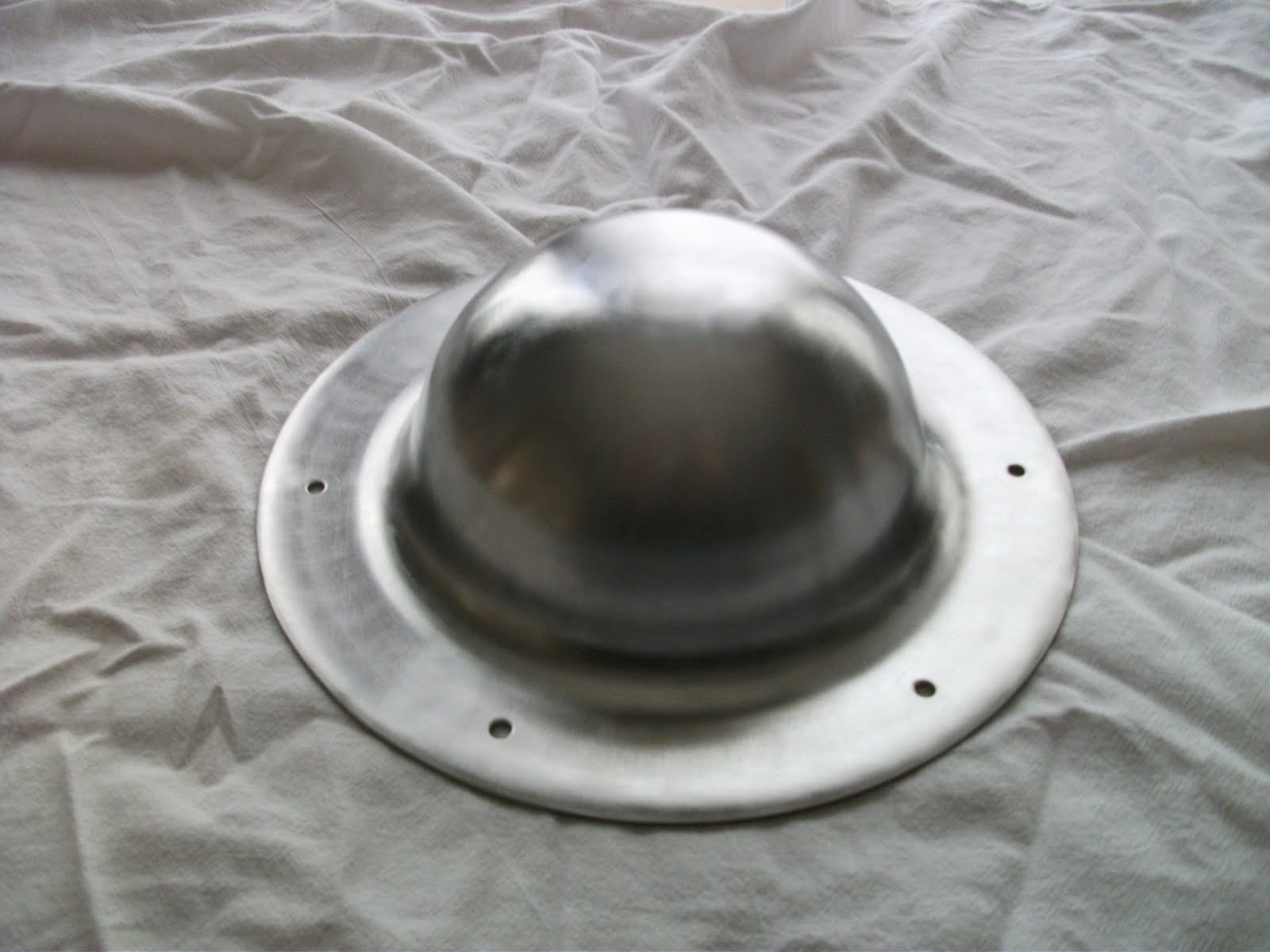

The shield boss arrived today from Windrose Armories. Rather than just slap it on the plank shield, I'll customize like I've done with previous hilt work.
I removed the nice, shiny finish it had with a pad of scothbrite, then went over that coarse finish with a fine dremmel buff to give it satin, hammered appearance.
Next step will be oven bluing -- this should be no problem with this mild steel shield boss.
I may try to buff a design onto the boss, then re-blue, or possibly etch something using the carved wax and 9 volt battery process.
Temperature in Celsius.
2011-11-03
Viking Shield


Historically, Viking shields were made with a wood similar to basswood, and designed to be lightweight with a typical thickness of 1/4", diameter ranging from 24" to 30", and weighing about 7 pounds. Cut for a center grip with a metal shield boss to protect the hand, shields were used to parry rather block. A linen or leather cover greatly increased the durability of the shield by preventing splitting: without linen, a shield would split and become useless after about 4 solid axe blows, with linen, the shield would not split, and could still be used effectively after many more blows.
My goal for this project will be to create an authentic looking shield that is as historically accurate as possible, lightweight, but strong enough to be useful during a Zombie Apocalypse. For the core I will use a combination of 1/8" plywood, 1/8" poplar planks, and canvas, cut to 24" diameter.
Subscribe to:
Posts (Atom)